"Americans’ Role Seen in Uganda Anti-Gay Push"

According to the above linked NYT article, American evangelical anti-gay activists were influential in Uganda's recent move to make homosexual behavior a capital offense.
Many Christian groups view homosexuality as a movement, even one that recruits. From reading the article it appears that the individuals in question here held views on homosexuality that were in line with that stereotype. My guess is that the Americans who may have "inspired" Uganda's new draconian legislation, do not think homsexuals should be executed, though this appears to be the take home message received in Uganda. This may be a story that epitomizes an interesting trend in American religion, namely that political and social impact of the hate the sin but love the sinner philosophy. A trend that allows religious objections to behavior, pregnant with negative social impact, to be couched in a veil of humanistic concern and even empathy. This view certainly has precedence within the Bible texts, and has some potential social adaptiveness associated with it, but pragmatically is often taken by those within religious bodies with a more authoritarian set of views and used to rationalize all sort of horrid social stances on a variety of issues, in this case the treatment of homosexual individuals.
The view that one can abhor the behavior of another yet love the other nevertheless, certainly has some intuitive appeal. I doubt marriages or other long-term human relations could survive long without some similar sentiment being present in heavy doses. The need to distance the behavior from the person has inherent adaptivity in certain social situations. This view also serves to reduced cognitive dissonance, i.e. it's not that I hate someone it's that I hate their behavior - we get to express emotion without having to feel like a bad person. However, the tendency to create in-groups and out-groups and seek to subjugate and oppress members of the out-group so members of the in-group can maintain power is also extremely adaptive. I think the former tendency (as manifested in the views of most Evangelicals to not wish LBGT individuals any ill, but to rebuke their sexual behavior) has been co-opted by adherents to the latter tendency in the Ugandan case. Put simply American Evangelicals' ability to hold in dynamic tension their love of people with their rejection of a specific behavior seems to have (charitably speaking) been hijacked by authoritarian elements of the culture at work in Uganda.
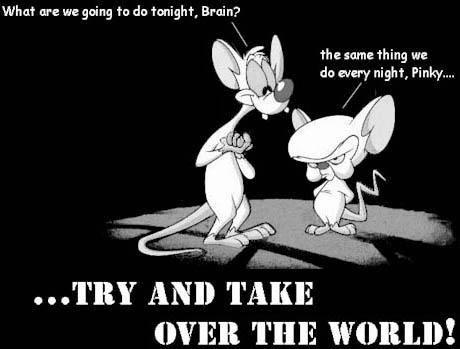 OK so that's my kind-hearted take on the whole thing. If I let the cynicism out (not hard to do in my case) and look for the heart of darkness in the motivations of the Evangelicals involved in this debacle, I'd focus on their beliefs that homosexuality is a "movement", with meetings, recruiting strategies, and some sort of vague aspirations toward world domination. It all begins to sound like an episode of Pinky and the Brain written by a 13 year old boy insecure in his gender identity. So while their viewpoint gives lip service to love the sinner hate the sin sentiment, it also implies that the sinner is a member of a furtive political group seeking to entice otherwise straight men into the pleasures of gay sex. You can't say you love the sinner, but by the way the sinner is trying to topple your society, and still claim any sort of vaguely affectionate stance towards the target group. That's not really separating the person and the behavior. That's like saying, hey my husband is horrible at cleaning the house, but I can recognize that is his behavior, not "who he is"....but I can confidently assert that his untidiness is part of a long-term effort to kill me through exposure to germs...but again he's really a descent person. My point being that once accuse someone of being a member of a group seeking to topple society, there's really no reasonably logical way to step back from that and "love the sinner". These pious individuals who traveled to Africa to share their fears on the homosexual menace should not be surprised when people actually listened and decided they should kill this group of people who are going to steal their children, make them have gay sex, and essentially destroy the country.
 Interestingly many scholars have argued that authoritarianism is an adaptive necessity, at least as a tendency. Authoritarianism is about being able to commit to and follow a social order, without questioning, and including acting out aggressively against threats to that order. So how is the above any different than what the Greatest Generation did in WWII? The difference, as with many things, is that in the EXTREME authoritarianism inhibits the generation of adaptive behaviors in the face of social stimuli that contradict one's held beliefs. When people came back from WWII they just wanted to live their lives, and repeatedly showed a distaste for pursuing any strident political or social ideologies regardless of their political stripes (though their children showed no lack of thirst for ideology writ large). One can only do more of the same if they are in the extreme authoritarianism camp - adhere more rigorously to the powerful group's ideology, rationalize more and more actions to stymie feared out-group members. Even still, as I used to say to my students, who would you rather live besides Ned Flanders or Homer Simpson....I'm going with Ned. Point being that authoritarianism is potentially a manifestation of social and group bonding necessary for our survival and coexistence.
Synthesis: Even if you are careful to stipulate that your rejection of a certain social group whom you believe is intent on destroying society does not include an endorsement of the eradication of said social group and that members of said group are really "nice people", don't be surprised when many people can't follow your nuanced prejudice....or beware American Evangelicals bearing PowerPoint presentations abroad.
Wikipedia - Right Wing Authoritarianism


 Posts
Posts

